
As I have said before, dance is a language that has always been a mystery to me. When the beat hits my feet I am always the first on the floor and the last one off it, but that is a more primitive version of physical expression than the amazing performances I witnessed in this show. As with all foreign languages, the best way to learn is to immerse yourself in them and pick it up as you go along. The physicality, subtlety and expression were breathtaking which meant that I could follow the gist of it even if the nuances went over my head.
The programme lasted for two hours with a couple of fifteen minute intervals, meaning that the dances themselves lasted an hour and a half. On looking at the Cast Sheet we were given, I was stunned to see that five members of the ensemble; Doma Ashory, Teige Bisnought, Aaron Chaplin, Yasmina Patel and Dylan Springer, were in all three pieces, their fitness and capacity for absorbing the choreography can only be marvelled at.
Loss.
The programme began with an interpretation of Mozart’s Requiem Mass in D Minor, choreographed by Dane Hurst, who was Phoenix Dance Theatre’s Artistic Director when the piece was first performed in full on 26th May, 2023 at Leeds Grand Theatre. I was fortunate enough to have been there when it was staged in conjunction with Jazzart Dance Theatre of Cape Town and The Orchestra and Chorus of Opera North, whose singers occupied the stage along with the dancers. Tonight’s abridged performance, under Dramaturge Mbulelo Ndabeni, saw the company have the space to themselves so my attention could focus on their movement, the accompaniment being provided by recordings. The stage was black, as was the back wall, the only props being two benches. The costumes, designed by Joanna Parker, were subdued shades of khaki making the lighting, by Luke Haywood, all there was to contrast with the otherwise doom laden atmosphere. When I say contrast, the actual effect was to add to the sombre nature of the message, which was, in the words of Dane Hurst, ‘to honour the people who lost their lives in the global pandemic, help make peace with that time and help us let go and move forward together.’

The message came through loud and clear thanks to the sensitivity shown by the aforementioned dancers and the others joining them in this work; Graciela Mariqueo-Smith, Hannah McGlashon and Tony Polo.
The two benches were utilised by four of the cast sitting on each for a part of the piece whilst their colleagues acted out their story in turn. Although there were some joyful interludes, the overwhelming impression was one of torment.

At this point I would just like to say a word or two about the audience, which was made up of a large proportion of young people, although, when you get to my age, everyone is a young person. They were superbly well-behaved throughout the dancing but, at the end they immediately rose to their feet and began whooping and hollering. Much as I admire the enthusiasm of youth, OK, make that envy, it abruptly shattered the emotional mood the work had instilled in me. My consolation was that it made me suspect I had perhaps appreciated and understood the work more than I realised, and certainly more than the atmosphere-hoovers, who evidently felt nothing.
Legacy.
From music written in 18th century we come right up to date with a World Premiere composed by David Preston, called Cloudburst, and is the first stage commission for Phoenix Dance Theatre, by choreographer Miguel Altunaga. He has collaborated with the company before, in 2021 when he created EBÓ, a film, as part of their inaugural Digital Programme designed to keep dancing, creating and entertaining audiences during Covid when theatres were closed.
Although multi-racial, Phoenix started life in 1981 when three black Leeds lads; David Hamilton, Donald Edwards and Gilmore James, who had had their enthusiasm for dance sparked by the tuition and support they received in school, decided to follow their dream. This meant that, as well as Covid, the Black Lives Matter movement also influenced the company and its direction.

EBÓ, which means sacrifice, was inspired by Yoruba and Afro-Cuban ceremonies, tales and culture, paying tribute to ancestors and those who lost their lives in the pandemic. Cloudburst is about shedding the past and questions the obstacles we need to overcome to move forward. Although a personal story it could easily be a universal one.
This piece was performed by the five core dancers mentioned above, who were all dressed in white, possibly a reference to clouds, by Costume Designer, Melissa Parry. It opened with an a cappella song followed by the sound of running water and thunder. The music became discordant as the dance involved the principals convulsing, following which, the other four appeared to perform rituals to tribal music.

This time the only prop was a large vase from which the dancers drank to a background of screams and a slow drum beat. The effect of the contents seemed to be hallucinatory as those who partook writhed around the stage with the others trying to calm them. At one point the vase was removed but was later brought back with similar results.
The Lighting Design was by Luke Haywood, this time relying heavily on spotlights to set the mood, but, once again, the whoopers quickly broke the spell.
Love
The evening ended with Terms of Agreement, a piece set to popular songs and the spoken word, choreographed by Marcus J Willis and written by Tomos O’Sullivan, who also acted as a narrator along with Frances Charteris and Chinwe Chong. The Rehearsal assistant was Anna Watkins. It is the third in a series of works called Terms and Conditions and expands on the examination by the first two on the question, ‘what is true love? and once you have negotiated the the terms, will you accept the conditions?
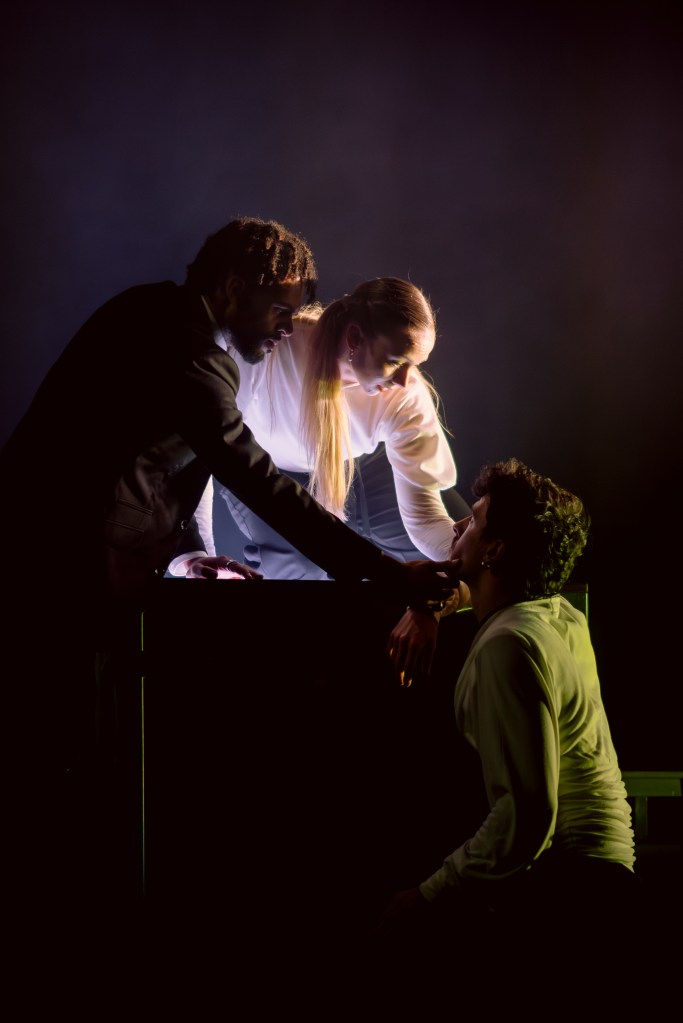
This time, the core of five dancers was joined by Phiko Luke, Hannah McGlashon and Tony Polo who took their seats at six tables, designed and produced by Hornsby Carpentry and Projects & Scenelux, arranged in a square U shape as in a classroom or office meeting. Each had an illuminated top which, when lit, shone either white or red. Once again, the set Lighting Designer was Luke Haywood.
There appeared to be some other colour coding involved in the costumes, designed by Melissa Parry with three men wearing trousers and black socks, whereas all the women and two skirted, or kilted men wore red socks. Most were dressed in black but a woman and two men wore white shirts. The relevance of this escapes me.
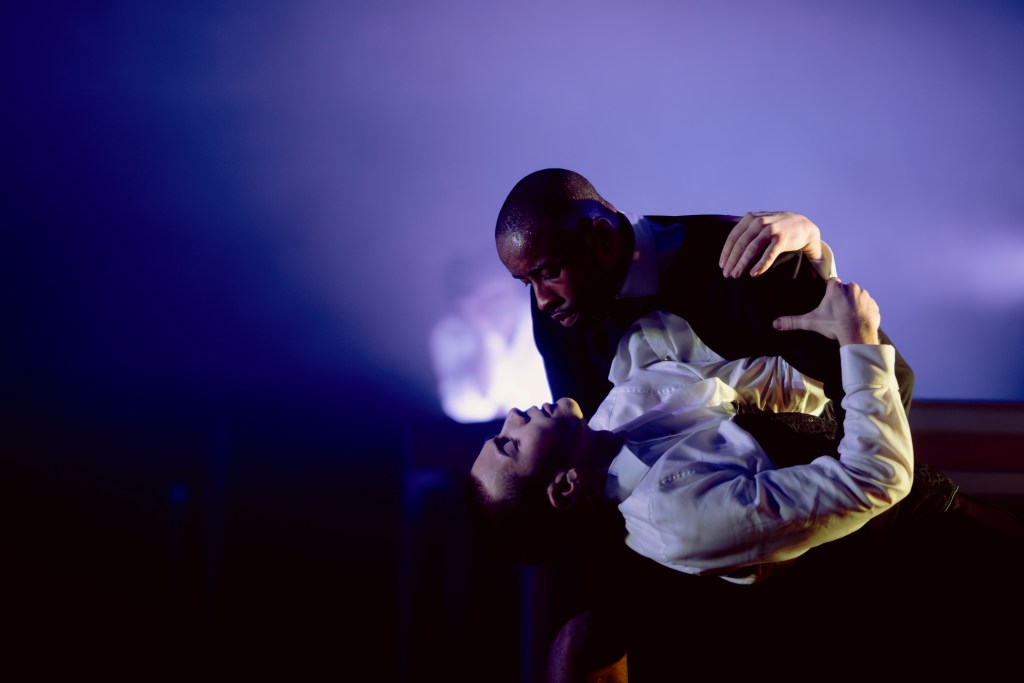
The programme says that Mr Willis ‘wanted to take the opportunity to create different scenes or scenarios based on different forms of love. These scenes are explored through is lens whilst also offering the opportunity to you as the audience to consider what true love means to you.’
The form of the dance with various combinations of two or three participants either in embrace or conflict seemed to indicate that not all of the relationships portrayed were running smoothly and the periodic meetings around the table with all dancers sitting, seemed to suggest that the terms and agreements of the title were being thrashed out, with a woman in a white shirt appearing to facilitate the meeting.

I deemed this work to be a little beyond my limited knowledge of the medium so I just marvelled at the way in which the dancers used their bodies in ways I could never dream of doing, and listened to the music. Regardless of whether I ‘got it’ or not, I thoroughly enjoyed the whole evening on its merits as skilful entertainment performed by participants who were obviously incredibly gifted in the execution of their art.
By the end, not even the whoopers, who went into overdrive when the whole of the cast and creatives took a bow, could spoil my enjoyment of a performance which I hope advanced my knowledge of the language of movement a little bit. I now look forward to the next production when I hope to progress a tad further. I would suggest that you might like to try this art form yourself, should you be verging on taking the plunge and trying something new, as the programme was varied and interesting enough to demand attention throughout. The music was also pretty darned good.
Although only running at Leeds Playhouse until 23rd February, Belonging: Loss. Legacy. Love. is on tour until 4th May, with more dates in Yorkshire. The full list of venues is : 28th February, Dundee Rep Theatre; 8th March, Everyman Theatre, Liverpool; 22nd and 23rd March, The Place, London; 19th April, Malvern Theatres, Malvern; 24th April, Cast, Doncaster; 3rd and 4th May, York Theatre Royal. For more details and to book tickets please go to https://www.phoenixdancetheatre.co.uk/whats_on/belonging/
To see the Official Trailer for Belonging have a look at https://www.youtube.com/watch?v=BTv1T_JRLdM&t=15s
The full version of Requiem, which I mentioned at the start of this article was performed on BBC4 and is available to view on BBC iPlayer until its December, 2024 at https://www.phoenixdancetheatre.co.uk/whats_on/requiem-on-bbc-iplayer/
To find out more about Phoenix Dance Theatre it is https://www.phoenixdancetheatre.co.uk/
For information about future events at Leeds Playhouse go to https://www.leedsplayhouse.org.uk/whats-on/
Feature image supplied by Phoenix Dance Theatre. All photographs by Drew Forsyth.

